Why Magoma Space?
Magoma Space is a space where thinking still matters. A space not driven by the oversupply of content or AI generated quick hacks, but by slowing down and forming our own. Here, ideas are explored not imposed, and conversations are encouraged rather than concluded.

Why read this article?
Everyone goes through highs and lows frequently influenced by their risk tolerance and timing. In these moments you might come across individuals who project negativity toward your choices or ideas. If you’re already struggling with self-doubt then this outside resistance might cause you to quit sooner than you otherwise would. You can’t fully fault them for the criticism or yourself for heeding their opinions. The roles change, there will be times when doubt is directed at you and times when without realizing it you cast doubt on someone’s aspirations. Many of us are unaware of how our words affect others and we can never be entirely certain of their impact as that is nearly impossible. However we can choose to be mindful not to dishearten anyone or present them with a narrative.
I’ve lived through both sides. A few years ago, and again recently, I found myself navigating risky decisions. Some close people expressed doubt. At the time, I interpreted it as concern because it came from family and still I went ahead anyway, with clarity and conviction, and achieved what I set out to do. Years later, similar circumstances appeared again except this time, I was feeling low. I noticed how different doubt feels when confidence is fragile. I also noticed how easily we label such reactions as jealousy, crab mentality, or human nature without asking why this happens, who does it more often, and how one should respond. Is it better to confront it or simply disregard it?. To write people off by calling them “Bad”?
“This article is my attempt to think through those questions, not to label people as good or bad, but to become more aware of how the mind reacts to progress, both in others and in ourselves.“
let’s get started,
Prior, to beginning essential information > Proceed to the next section
- Crab Mentality (Crabs-in-a-Bucket Effect)
- The Brain’s Self-Defense Mechanisms
- Social Comparison and Group Dynamics

- Crab mentality is essentially a voice that murmurs: “If I can’t have it, then neither can you.” In social environments it appears when someone strives to advance while others, either intentionally or unintentionally try to hold them down by means of deterrence, control or indirect obstruction. This phenomenon is often known as the Crabs in-a-Bucket Effect.
An individual crab in a bucket is able to climb out. When several crabs are grouped together any crab trying to get away is dragged back down by the rest. It’s crucial to note that this tale serves as a metaphor for human group behavior in settings influenced by insecurity and rivalry. Among people when one advances within a group it can reveal anxieties in others, such as worries, about inadequacy, lack of progress or being abandoned. Pulling someone back becomes a way to protect one’s self-image rather than confront discomfort. - The brain’s self-defense against discomfort, Whenever we face something unfamiliar, risky, or uncomfortable, the brain instinctively moves into defensive stance to protect us from the unknown. This is not because the brain is malicious, but because it is loss-averse, it prioritises safety and familiarity over growth. A simple example is physical discipline, when someone starts going to the gym consistently, the body begins to ache. Soon, an inner dialogue appears, “let Rest today.” “You don’t really need this.” “You’re already better than most.” The brain constructs stories which are not always true to avoid discomfort and preserve the status quo. This same mechanism activates when we witness others taking risks or progressing. Their movement forward becomes a reminder of our own inaction, and the brain responds defensively.
A Universal Personal Experience: While searching for jobs I disliked the process since I viewed it as time wasted searching, than working. Whenever I felt overwhelmed I would subconsciously spot something in the job description that disqualified me from applying. After encountering 5-6 such positions I would blame the job market and call it quits for the day. - We are influenced by who we surround ourselves with. People often claim that we mirror the traits of those we spend the most time around. If taken at face value this may seem overstated, simply associating with individuals does not ensure success yet the influence exists. Social settings mold standards, drive ambition tolerance for risk and confidence. Gradually it is the behavior, not fate, that gets shaped.
Hence the problem seldom lies with society in its entirety but, with close contacts. Specific mindsets group together strengthening either progress or stagnation. It establishes the foundation for achievement and insights. The ultimate objective invariably relies on the person, typically the one, in charge.
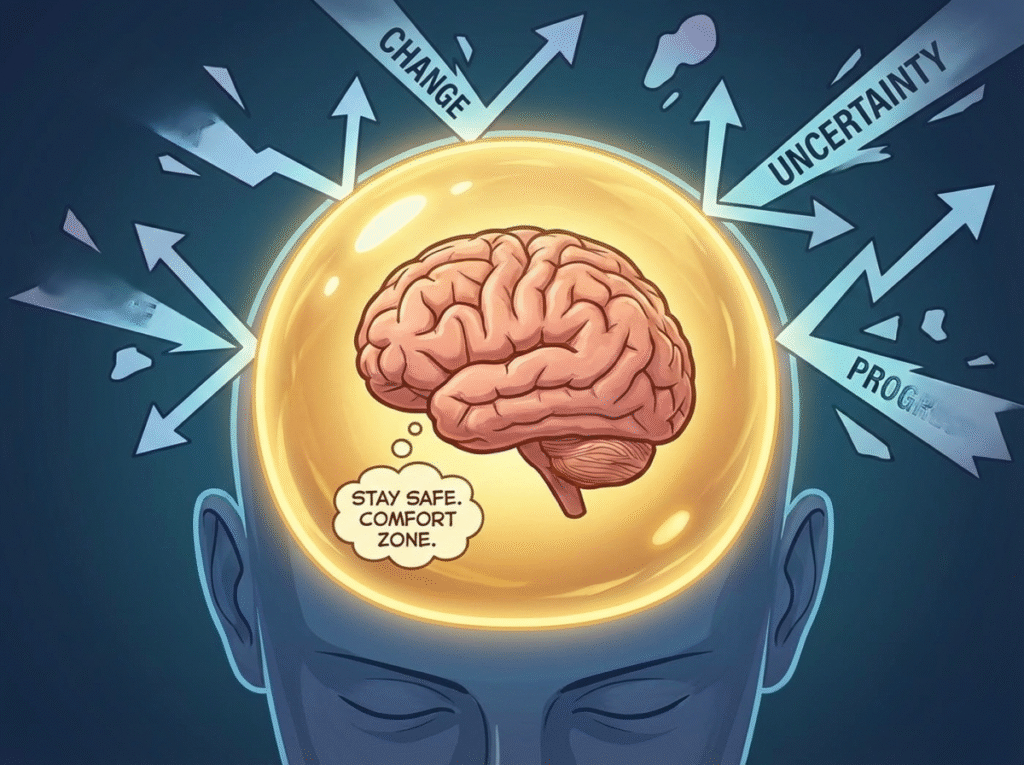
So, essentially Why envy feels strongest toward people we know?
Envy rarely targets strangers. It concentrates on people close to us like friends, colleagues, relatives — because they belong to our reference group. Strangers don’t threaten identity. Their success feels distant, unrelated, and non-judgmental. But when someone close progresses, it activates upward social comparison. The mind starts measuring the potential, effort, timing, opportunity. More importantly, it imagines social judgment “If they succeeded and I didn’t, what does that say about me?” and what would others think about me? This is not always conscious. It is the brain combining comparison, identity threat, and fear of being left behind together creating the envy we know towards the people who are closer to us.
When crab mentality, social proximity, and the brain’s defense mechanism intersect, a pattern emerges. Someone close progresses > identity feels threatened > the brain fears the societal judgment > defensive reactions appear. These behaviors might manifest as worry, critique or discouragement yet they frequently represent efforts to regain psychological balance and don’t actually indicate a desire to block your progress, they simply prefer you not advance beyond their own level. This shouldn’t be interpreted as people being malicious. This implies the mind is skewed toward safety, than development.
While writing this article, I came up with this simplified framework.
(This is a mental model nothing universal)
1. Individual out of shape / Group progressing
Discomfort is high. The individual may try to fit in artificially, seek approval, or quietly distance themselves. Gratitude and authenticity shouldn’t be expected by the individual.
2. Individual progressing / Group out of shape
The individual is frequently discouraged or distracted. Outcomes usually split three ways: leaving the group, attempting to uplift the group, or giving up progress to maintain comfort.
3. Individual progressing / Group progressing
The healthiest combination. Support is mutual, competition is constructive, and success is not treated as a threat but as proof of possibility.
4. Individual out of shape / Group out of shape
Stagnation becomes normal. Risk is avoided, blame is externalised, and criticism of others replaces self-reflection. Energy is spent observing others rather than improving oneself.
Counterviews (Don’t want to have a one-sided Story)
Not every negative reaction to success is “Crab Mentality”. Some criticism maybe legitimate (safety concerns, Fairness concerns) Sometime they don’t want you to fail hard enough that it breaks you. Labelling all the pushbacks as sabotage flattens the nuance.
Competition can serve as motivation: Rivalry that inspires others to enhance themselves is not destructive. Differentiate pressure (which can boost performance) from sabotage (aimed at undermining another’s advancement).
Why it is not good for you with a personal story,
Time: The most irreversible cost is time. Every minute spent analysing someone else’s progress, intentions, or trajectory is time stolen from your own growth. Over time, this becomes a habit and believe me this habit won’t do any good to you.
Social Capital Depletion: There may be a short-term emotional comfort in discouraging others or maintaining the status quo. But over time, the trust erodes. People sense environments that are unsafe for ambition and they find a way of avoid it at all cost. Supporters fade, guidance vanishes, connections diminish, without notice.
Perpetual stagnation: When ambition is punished, stagnation becomes the norm. Groups that level those who try eventually trap themselves in mediocrity. Growth doesn’t disappear dramatically, it simply stops showing up.
So What? (Conclusion)
Envy is not a curse unique to a few people, no one is immune to it. It is a normal response of the brain, triggered whenever identity feels threatened. Most of the time, you won’t even recognise it unless you know what to look for. It appears quietly as concern, hesitation, advice, or silence and more often than not, it shows up in interactions with those closest to us, where comparison carries the most weight. The discomfort others feel around your growth is usually a reflection of their own internal negotiation with fear, not a verdict on your direction.
At the same time, when the situation is reversed, this awareness asks something uncomfortable of us, to notice when the same reaction arises within ourselves. The moments when we subtly hope someone slows down, when comparison begins to quietly drain our focus. Growth, then, becomes less about outpacing others and more about recognising these signals without acting on them.
For the mind to grow out of this, it doesn’t require fighting, or proving anything. It requires clarity, restraint, and the discipline to keep moving. In the end, it’s always you versus you. Focusing on your own progress matters far more than whether you are moving faster than someone else.
This is my first article, one that took months of procrastination, reflection, and reading. If you have experiences or perspectives of your own, this space is open for discussion. Conversations like these are how clarity grows.
Content References
- Festinger, L. (1954). A Theory of Social Comparison Processes.
- Tesser, A. (1988). Self-Evaluation Maintenance Model.
- Kahneman, D. (2011). Thinking, Fast and Slow.
- Kahneman, D. & Tversky, A. (1979). Prospect Theory.
- Smith, R. H. & Kim, S. H. (2007). Comprehending Envy.
- Baumeister, R. F. & Leary, M. R. (1995). The Need to Belon.
- Tajfel, H. & Turner, J. C. (1979). Social Identity Theory.
- Feather, N. T. (1989). Attitudes Toward High Achievers.
- de Botton, A. (2004). Status Anxiety.
- Grant, A. (2013). Give and Take.
- Organizational psychology literature on Crab Barrel Syndrome.